
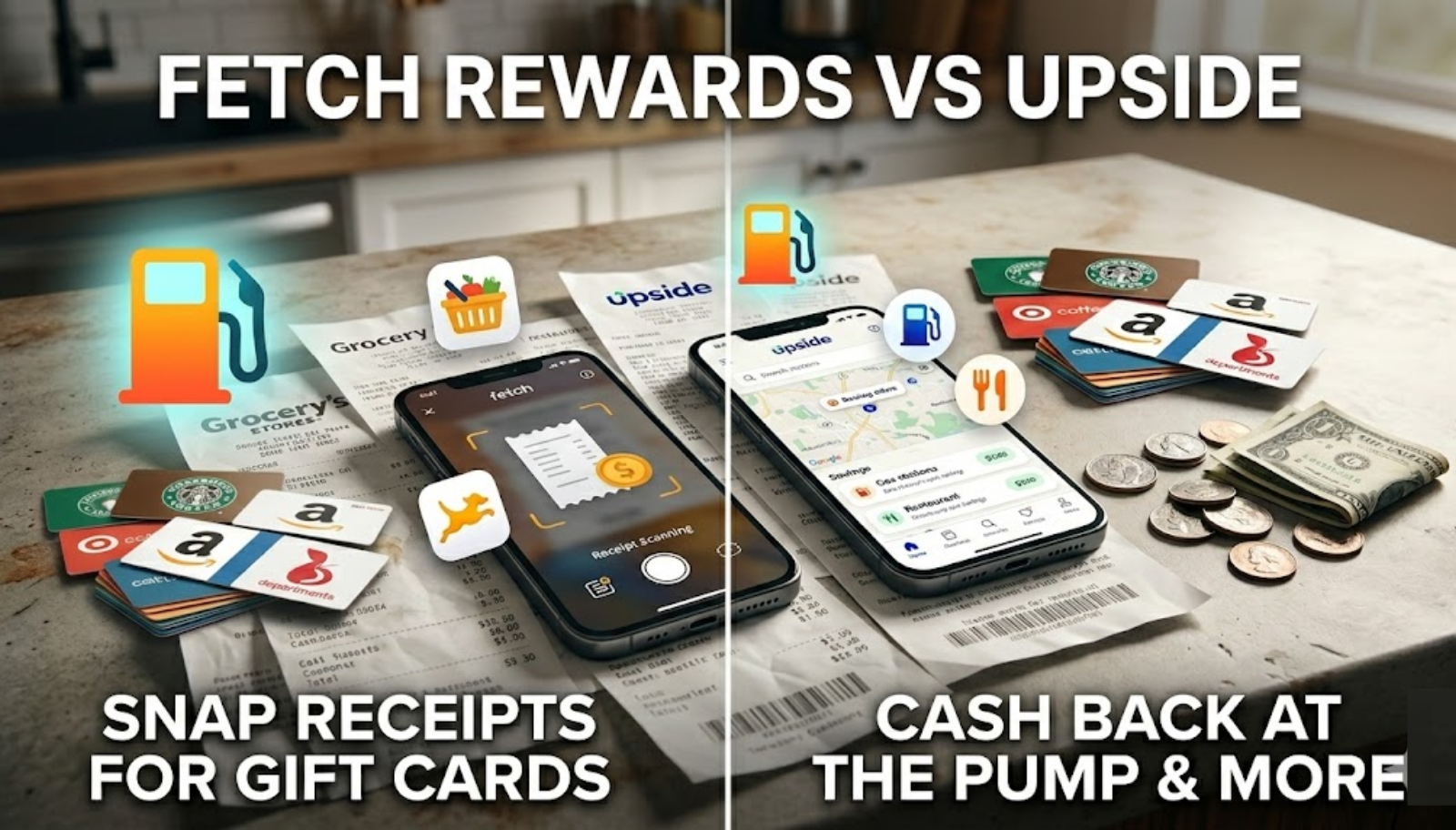
When weighing Fetch Rewards vs Upside, if you want a set-it-and-forget-it tool that protects you from high gas prices, Upside is probably your best bet.
Transparency Note: My Cash Back Reviews is an independent site. I personally test cashback apps and rewards programs to provide honest, practical guidance. This post contains affiliate links; if you use my links to sign up for services I recommend, I may earn a small commission at no additional cost to you, which helps support this site.
When looking at Fetch Rewards vs Upside, if you had to pick just one to focus on, which one should you choose?
Well, the short answer is that they handle your money completely differently. One turns your everyday grocery runs into free gift cards, while the other puts cold, hard cash back into your checking account every time you fill up your gas tank.
Let’s break down how they actually work side-by-side so you can see where your time is best spent.
Fetch Rewards vs Upside: The Quick Breakdown
| Feature | Fetch Rewards | Upside |
| Primary Focus | Groceries, shopping, & digital receipts | Gas stations, restaurants, & select grocery stores |
| How You Earn | Snapping photos of any store receipt | Claiming offers and paying with a linked card |
| Payout Options | Gift cards (Amazon, Starbucks, Target, etc.) | Direct deposit, PayPal, or gift cards |
| Effort Level | Medium (You have to manually scan physical receipts) | Low (Mostly automatic after you claim the deal) |
Fetch Rewards: The Grocery King
Think of Fetch as a giant digital scavenger hunt for your grocery cart. You buy your normal food, grab the receipt, and snap a picture. Boom, you get points.
Actually, it’s even easier than that if you link your digital accounts. You can connect your Amazon or Walmart accounts, click a button, and let the app scan your e-receipts while you sit on the couch.
- The Big Pro: It accepts almost any receipt. Did you buy a pack of gum at a gas station convenience store? Scan it. Target run? Scan it. You always get a minimum base payout of 25 points.
- The Catch: You only get the massive point boosts if you buy specific name brands, like Pepsi or Kraft. If you mostly buy store brands or fresh produce, building up enough points for that $25 Amazon gift card can feel a bit slow.
Bonus Tip: If you haven’t signed up yet, you can use a referral code like NCTUU3 when you get started to score a chunk of bonus points right out of the gate.
Upside: The Fuel Saver
Upside takes a totally different approach. Instead of tracking your shopping cart, it’s designed to shield your wallet from brutal prices at the pump.
Before you roll up to the gas station, you open the app, find a station near you offering maybe 15 or 25 cents back per gallon, and click “Claim.” You pay with your normal credit or debit card, and within a few days, real cash shows up in your account.
- The Big Pro: It’s real cash. You don’t have to trade it for a Starbucks gift card if you don’t want to; you can send it straight to your bank account.
- The Catch: You’re limited to their specific partner stations. If you live in an area without many participating Shell or BP stations, or if you exclusively fill up at Costco, the app won’t do much for you.
In My Experience: How to “Double Stack” Both
Here is a little secret that a lot of people miss. You don’t actually have to choose between them when looking at Fetch Rewards vs Upside. Because they look at different parts of your transaction, you can double-dip on the exact same trip.
Maybe you—wait, let me rephrase that. Let’s say you pull into a gas station that is a partner on the Upside app.
- Open Upside and claim the gas discount before you pump.
- Pay with your card to get your Upside cashback sent to your bank.
- Walk inside and buy a snack, or just grab the physical receipt from the pump.
- Open Fetch and snap a picture of that exact same receipt.
Just like that, you earned real cash back on the fuel through Upside, and you grabbed extra gift card points on Fetch for the exact same stop. It’s similar to how I automate things in my Bridge Money App Review or maximize savings using a Fluz referral code—layering tools is always the best strategy.
My Personal Take on Using Fetch and Upside Together
I’ve tested both platforms extensively, and the biggest lesson I’ve learned is that they aren’t competitors—they are partners. Fetch is my “catch-all” for every single grocery receipt I get, while Upside is my “precision tool” for fuel and dining. My “Pro-Tip”: Don’t overthink it. Just make it a habit to open both before you even leave the gas station. I treat Fetch as a way to build up gift cards for my “fun” spending, while the cash back from Upside goes directly into my checking account to offset my actual fuel costs. By stacking them, you’re essentially getting paid twice for the exact same trip.
The Verdict: Which One Wins?
If you want a set-it-and-forget-it tool that protects you from high gas prices, Upside is probably your best bet. But if you do the majority of the grocery shopping for your household and love racking up gift cards, Fetch Rewards is going to give you a lot more consistent wins.
Frequently Asked Questions
Q: Can I really use both apps on the same receipt? A: Yes! Because Fetch rewards you for the store purchase itself and Upside rewards you for the specific fuel or dining transaction, they rarely overlap in a way that causes issues. You can absolutely use Upside for your gas discount and then scan the same receipt into Fetch to get your points.
Q: Which app should I prioritize if I’m short on time? A: If you only have time for one, prioritize Upside if you are filling up your gas tank, as it provides direct cash back. If you are doing a large grocery haul, prioritize Fetch Rewards because the point potential for specific brand-name items is significantly higher.
Q: Is it safe to link my bank account to these apps? A: Both Fetch and Upside are legitimate, established companies that use industry-standard encryption to protect your data. If you are ever hesitant about linking your main bank account, you can use a secondary “everyday” checking account or a dedicated rewards card to manage your cashback transactions safely.